russia.
date. 2026
city. moscow, suzdal, vladimir, saint petersburg, murmansk

July 17, 2026 – Sheremetyevo International Airport
In the gutters of the boulevard of world civilization, there lie the bodies of those leftover persons who’ve been brushed aside to further smoothen the path of the masses.
I’ve encountered these castaways before. In hospital waiting rooms, on park benches, or shuttling along on subway seats after dark.
But mostly, the machinery of Good Governance does its job, sweeping up the crumbs into a vast network of prisons, rehabilitation centers, military units, and miscellaneous shelters. Most often, when everything goes to plan, the undesirables are kept out of sight of society entirely.
One of the more effective filters we have is the international airport. As I disembark at Moscow’s Sheremetyevo airport, hurrying along its hallways, escalators, and moving sidewalks, I unwittingly pass a dozen of spaces where the undesired visitors get picked up before they can reach the Arrivals hall. Holding cells, interrogation rooms, detention centers. All completely invisible to someone like me. Someone with the right passport, the right religion, and the right skin. Someone who belongs.
But today is different. Today, I am introduced to that uppermost layer of the Great Filtration System.
When I pass my passport to the immigration officer, I am told that I require Additional Screening. I am told to sit and wait. That is all. Wait.
After 20 minutes, I am escorted to another Waiting Area. I am told to wait. Just wait.
While I wait, I talk in broken phrases with the other broken crumbs. A middle-aged couple from Sri Lanka tell me they’ve come to collect the dead body of their son who was killed in Ukraine. The mother stares blankly at me. Her eyes are filled with love and loss. I recognize those eyes.
She grips the death certificate tightly in her left hand, clinging to her boy. Clinging to her evidence that she is not a crumb. That her dead child is not a crumb.
The father asks me how old I am. He wants to know if I talk to my parents.
A young man from Uzbekistan dashes wildly around the Holding Area talking to anyone who will listen – and a few who won’t – in a stream of Uzbek. He’s worried about his luggage. He speaks neither English nor Russian. A crumb.
A man from Tajikistan sits silently. They’ve taken his phone and his passport. He’s been waiting for 5 hours. I ask if he’s been interviewed yet. “Mnoga, mnoga,” he tells me.
I wonder to myself: Am I a crumb too? With my crisp visa pasted in my shiny new American passport, will I too be cast away? And why shouldn’t I be?
After an hour of waiting, I am brought into a small white room. There are no windows. Two men, about my own age, sit behind a desk. One is tall and slim. He asks the questions. The other is large. He sits silently, watching me. A Russian flag is pinned to the wall behind them. Otherwise, the room is bare.
I began studying the Russian language 9 months ago. I never thought that the first time I would put it to real use would be during an interrogation by the FSB.
I’d been planning this trip for half a year. I insisted to all those who cautioned me against it that I really wanted to visit Russia. Well, here I am.
Over the next hour we reviewed every aspect of my financial, social, political, military, familial, and psychological life.
Prove to us, they seemed to be saying, that you belong. Prove to us that you are not a crumb.
For 33 years, I’d blindly walked past those who’ve been pushed aside. Now I am one of them.
Moscow – The Red Square
Looking into Napoleon's eyes, Prince Andrei thought about the insignificance of grandeur, about the insignificance of life, the meaning of which no one could understand, and about the still greater insignificance of death, the meaning of which no one among the living could understand or explain.
“How good it would be to know where to look for help in this life and what to expect after it, there, beyond the grave! How happy and calm I'd be, if I could say now: Lord, have mercy on me!... But to whom shall I say it? Either it is an indefinable, unfathomable power, which I not only cannot address, but which I cannot express in words— the great all or nothing. Nothing, nothing is certain, except the insignificance of everything I can comprehend and the grandeur of something incomprehensible but most important!"
Whatever he started thinking about, he came back to the same questions, which he could not resolve and could not stop asking himself. It was as if the main screw in his head, which held his whole life together, had become stripped. The screw would not go in, would not come out, but turned in the same groove without catching hold, and it was impossible to stop turning it. (Tolstoy, War and Peace)
Stepping into the Red Square for the first time, I am struck by the realization that all places are impossible. Each place must have a name. And as we know, all names are lies. Like a shell or a shield, they conceal the very thing they wish to present. And like a shell, they must ultimately be cast off. To be named is to be replaced. All places are impossible.
What remains once I’ve lost my ability to provide names or discover places? What remains in that infinite void?
Who was the most influential Jew in history: Karl Marx or Jesus Christ?
The people search, perpetually, for redemption. First in faith. Then in science. Why do both paths lead only around in the Empty? Why do they turn silently, pointlessly, like Tolstoy’s screw?
We build great idols. We worship them faithfully on our knees.
The Tretyakov Gallery
I pause before Nikolai Ge’s Heralds of the Resurrection.
The painting captures the immediate aftermath of Christ’s resurrection, but with a jarring omission: Jesus himself is entirely out of the frame. Instead of painting the divine event directly, Ge chooses to focus on its psychological impact.
On the left side of the canvas, Mary Magdalene is frantically sprinting toward the horizon, rushing to deliver the good news. Her body and hair are windswept, she’s barefoot, and a brilliant, ethereal light bathes her figure.
In sharp contrast, on the right side of the frame, a group of dark, somber Roman soldiers meander heavily in the shadows. They are completely oblivious to the miracle that has just occurred right beside them.
I google Nikolai Ge to learn more. Here’s what I learned:
By the late 1870s, Nikolai Ge was in a deep personal crisis. A co-founder of the famous Peredvizhniki (The Wanderers) realist art movement, he had grown profoundly disillusioned with the commercialized art world. He abandoned St. Petersburg, bought a modest farm in Chernigov (modern-day Ukraine), stopped painting, and tried to live a simple peasant life.
In 1882, Ge happened to read a newspaper essay by Tolstoy regarding the Moscow census, in which Tolstoy wrote deeply about the wealthy classes' lack of love for the poor. Ge later wrote in his diaries:
"I found words precious to me... I loved that man unboundedly, he had revealed everything to me. I could now name what I had loved all my life—he had named it for me."
Ge immediately traveled to Moscow, walked into Tolstoy's house, and embraced him. From that day forward, Ge became a devoted follower of "Tolstoyanism"—a philosophy emphasizing radical Christian pacifism, asceticism, and manual labor.
When Ge painted "What is Truth?" (1890), showing a haggard, physically beaten, and shadowed Jesus standing before a stout, radiant Pontius Pilate, the Russian Orthodox Church was outraged and the government banned the painting for blasphemy. Tolstoy, however, fiercely defended Ge, publicly stating that Ge had finally resolved the historical impasse of Christian art by depicting Christ not as a distant god, but as a living, suffering teacher of truth.
When Pavel Tretyakov (the founder of the Tretyakov Gallery I am now in) was hesitant to buy Ge's late, highly controversial, and grotesque depictions of the Crucifixion, Tolstoy intervened. Tolstoy used his massive cultural leverage to pressure Tretyakov, writing to him that Ge’s works were true masterpieces that humanity desperately needed.
Moscow is crammed with a great many small and twisting lanes. The buildings are mostly humble. The hills mild. The only structures that stand out are the countess colorful churches and the proud Stalinist Empire towers. God or World. Beauty or Power. Jesus or Marx.
Russia asks me blankly: Am I prepared for tragedy? Do I accept my life? Or do I cower before the Real?
Moscow is a city of encounters. East and west. Science and religion. Earth and heaven. Mind and matter. Blood and sweat. Beauty and death. Beauty and death. War and peace.
St Basil’s cathedral whispers in my ear: “life is more beautiful in person.”
While I live in a world struggling for meaning, Moscow lives in a world of good and evil. A world of consequences.
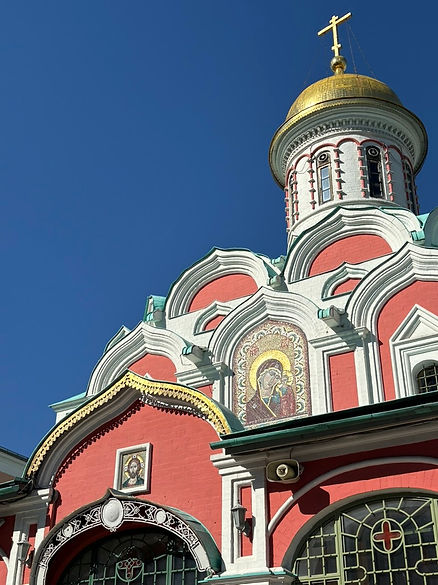
There are no seats in the Orthodox churches that I step into. Everything is coated in gold. Everything is colorful. God is beautiful, I’m being told. Everything is illuminated, shining, hundreds of candlesticks reflecting off polished gold. Christ’s torn body glittering like a sun. Do not date to linger. Pass through the nave, bathe in the light, and then right back out onto the street. There’s nothing to find here. Everything is out there. Waiting for you.
The Russian orthodox chapel grabs your attention. Like a holy magnet, it yanks your spirit right into the world. Splendid gold. Glistening jewels. RIGHT HERE. There is no suffering here. Only love and beauty. HERE. You don’t need to understand. God understands all. You need only to live. And suffer. HERE. In the Orthodox Church, there is no understanding. There is only presence.
The root of the Russian word for church (tsirkov) is circus (tsirk).
There are only two kinds of shops in Moscow that are open 24/7. The pharmacy and the florist. You never know when you might need to hold something beautiful.
On driving through the city — the Iverskaya Chapel with countless candles burning before the gold casing, the Kremlin Square with its untrampled snow, the cabbies, the hovels of the Sivtsev Vrazhek, old Moscow men, who desired nothing and were not hurrying anywhere as they lived out their lives, little old women, Moscow ladies, Moscow balls, and the Moscow English Club — he felt himself at home, in a quiet haven. For him Moscow was comfortable, warm, habitual, and dirty, like an old dressing gown. (Tolstoy, War & Peace)
The Kremlin
Moscow has always been the wrong place.
I’ve never been warned against visiting any place as much as Russia. For months, as I planned my trip, people from all backgrounds urged me to cancel it. The security director at the US embassy. My Kyrgyz friends. Russian emigres that I met in Bishkek. Heck, even the KGB officers who detained me when I arrived in Moscow thought it was a bad idea! But you know, this only made me more curious. I love a forbidden desire. I love an obvious secret.
I was told that it’s a bad time to visit Russia. There is no better time than a bad time.
I was told it’s a bad place to be. There is no better place than a bad place.
I don’t want to see an easy Russia. I want to see a forbidden Russia. After all, isn’t that how we all see Russia anyways? As forbidden?
I can’t shake the feeling that I’m living in a dream. Not quite dreaming; I am awake. It is certainly the world which is dreaming.
It’s not hard to write. It’s only difficult to think.
Only those who love the world can love themselves. None of the great religions have successfully taught us how to love everyone and still hate evil. No philosophy has solved this puzzle. Not even God can answer it. And yet it is a necessary truth. There exists a duality at the heart of everything. I hate violence and the love the soldier. I hate deceit and I love religion. I’m an atheist and I believe in God.
To exist is to love. To love is to damage. Ruthlessly. Stupidly. Constantly.
I strolled the Kremlin this morning. I entered her cathedrals. I came face to face with tyranny. I loved every moment of it.
If I am to be guilty, let me be guilty of this. Let me be guilty of love.
It drizzles down on me. As if for my atonement. Or are they tears?
I am bathed in life.
When he had reported to the regimental commander, had obtained an assignment to his former squadron, had been on duty and gone foraging, had entered into all the little concerns of the regiment, and had felt himself deprived of freedom and bound within one narrow, unchanging frame, Rostov experienced the same peace, the same support, and the same awareness that here he was at home, where he belonged, as he felt under the parental roof.
There was not all that disorder of the free world, in which he found no place for himself and made wrong choices; there was no Sonya, with whom he had or did not have to talk things over. There was no possibility of going or not going here or there; there were not those twenty-four hours in a day which could be spent in so many different ways; there was no numberless multitude of people, of whom no one was close, no one was distant; there were none of those unclear and undefined money relations with his father; there was no recollection of that terrible loss to Dolokhov!
Here in the regiment everything was clear and simple. The whole world was divided into two unequal parts: one was our regiment, the other — all the rest. And with this rest he had nothing to do. In the regiment, everything was known. (Tolstoy, War & Peace)
Kitay Gorod
I spent my last night in Moscow with N and her husband, D. We stroll for hours; they’re eager to show me their city. We march. And drink. D pulls beer after beer from concealed pockets, and as the sun sinks onto the horizon, we seem to sink along with it. We walk through countless alleys, cross over bridges, trudge up hills, as N points out palaces, mosques, and facades.
We march with determination. But where to, I’m unsure. We talk about everything except for that one thing.
Finally, after the 4th mile and the 5th beer, N confides that they’ve begun drinking too much. Each night, after their son goes to bed, they walk and drink. For hours. And smoke.
I keep quiet as she speaks. Pain does not need to be spoken. But then again, it does. D is in good spirits, but the kind of good spirits that screams of desperation. He nods effusively as N speaks.
Shiny Chinese cars fill the roads. McDonald’s has been renamed. We’re told that everything is okay. Nothing has changed.
D says that he doesn’t fall for it. He says that a Zeekr is not a BMW. He says that they’re life is being stolen from them, replaced with cheap plastic alternatives.
They want me to understand. They want me to understand that the Moscow that I see is not real. They want me to understand that they’ve lost everything; that they’ve lost it all for nothing. They want me to understand that they love their son and they want him to have a future.
N tells me that when Moscow was first bombed, her young son told her that he’s scared but that we deserve it because we started it. I could see in her eyes how proud she was. She repeated that last part: we started it. I saw that there could be redemption in guilt. Redemption in truth. Redemption in grief.
We started it.
By now it’s dark.
I notice that they’re scared. Their eyes constantly glance around. D hushes N when she speaks too loudly. But when I say out loud what we’re all feeling, they just laugh and tell me there’s nothing to worry about.
We stop to buy more cigarettes. D dashes into a liquor store for the fourth time. In four hours, we barely stop moving.
They show me where their son studies. “Top ten school in the country,” D proudly announces. “My son studies there,” he adds with a disbelieving chuckle. N mutters something cynical about what the pointlessness of studying in Russia. But I can see that she is also proud.
They want to escape. But as D promises to meet me in New York one day, N resignedly admits that she was born in Moscow and in Moscow she will die.
We pass the former KGB complex. Today it bears a new name.
We pass unmarked black cars. The new NKVD.
Around midnight we end up in a soviet pub. We drink pints of cheap beer, slurp herring and potatoes, and munch on Tatar Chebureki.
We finally stumble back to the hotel. I hug N tightly. We understand we might not meet again. D hugs me twice.
They love Moscow. But Moscow is hurting them.
I don’t know what to make of N and D. But I’m so proud to be their friend. Something tells me that they’re important.
He experienced the unfortunate ability of many people, especially Russians — the ability to see and believe in the possibility of goodness and truth, and to see the evil and falsehood of life too clearly to be able to participate in it seriously. Every sphere of work was, in his eyes, bound up with evil and deceit. Whatever he tried to be, whatever he undertook — evil and falsehood repulsed him and barred him from all paths of activity. And yet he had to live, he had to keep busy. It was too frightening to be under the burden of all the insoluble questions of life, and he gave himself to the first amusements that came along, only so as to forget them. He frequented every possible society, drank heavily, bought paintings, built, but, above all, he read. (Tolstoy, War & Peace)
Лета в Москве
Wherever I go, bright posters greet me with the words Лето в Москве – Summer in Moscow.
Revolutionary Square is hosting a chess tournament. In the shadow of the Karl Marx Monument, old men slouch over boards, dads play with their daughters. Friends battle each other.
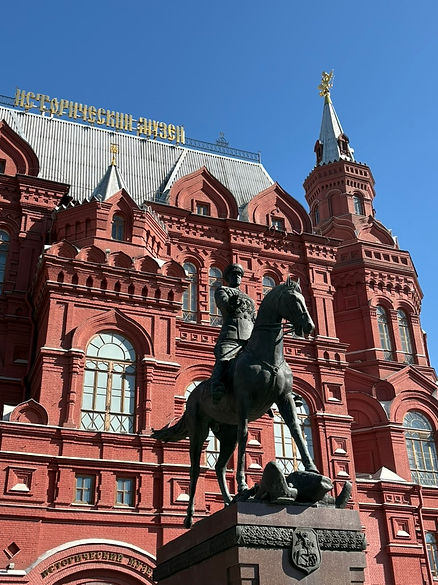
Just around the corner, in front of the State Historical Museum a happy collection of trees, benches, fountains, and pop-up cafes provide shade for weary shoppers.
A number of tennis courts have appeared in popular squares all around the city offering free lessons. Young girls in short skirts dart around the court.
Лето в Москве follows me around the city, begging me to enjoy the summer.
Drones dart down from the sky. The first aerial attacks on the largest European city since 1943.
It’s summertime in Moscow.
2,000,000 estimated casualties. Four bloody years.
It’s summertime in Moscow.
As I approach the Kremlin, the Bluetooth signal from my headphones cracks and dies. I open google maps; the GPS jammers show my location 10 miles away.
It’s summertime in Moscow.
Gorky park is full to the brim with smiling families and sweaty joggers. The sun is bright, the sky an impossible blue. The cafes don’t have enough space; we sit out on the stoop.
It’s summertime in Moscow.
My Russian is broken. My accent betraying passport. Everyone is patient and kind.
Ice creams stalls on every corner. A war memorial with photos of slain soldiers in Zaryadye Park; flowers from loved ones crowd around, wilting in the powerful heat.
K once told me that you can never have too many flowers. I laughed at her then. But how better to welcome the death that lurks just behind the golden domes of St Basil’s Basilica set on fire by the summer sun? How better to capture the beauty and the tragedy of
Summertime in Moscow.
Teenagers gathered in Kitay Gorod, filling up Gorka Park after dark with music and smoke. Black vans slowly drive past the streets below. Everything is calm. Everything is normal.
It was the season of Light, it was the season of Darkness, it was the spring of hope, it was the winter of despair, we had everything before us, we had nothing before us, we were all going direct to Heaven, we were all going direct the other way.
Summertime in Moscow.
N: I wouldn’t say that Russians aren't sincere. In my opinion, we’re actually sincere to a fault. Maybe what you see as sarcasm and irony is just a byproduct of our political system, where it’s difficult, and sometimes even dangerous, to call things by their real names. Sarcasm is becoming a habit.
Suzdal-Vladimir
I quote a glimpse of her face, just before she passed on the bridge. The boat she traveled on, gliding atop the smooth river. I stub out my cigarette on the stone church stairs and spill out the rest of my sun-warmed beer.
It seems to me that a country that disallows missionaries should certainly ban sales calls.
Across the impenetrable darkness that envelopes each of us, there is a shared space, in-between and nowhere at all, where we go to take solace. This is the place of language. In language, we truly inhabit a shared location – an impossible location – a location designed for communion. In language, we not only meet each other, but crucially, we come into contact, for the first time, with ourselves.
But what happens when there is no shared vocabulary? What happens when each person is left alone in their own dark corner of the infinite? I spent the weekend in Vladimir with A, exploring that question.
A speaks maybe a couple dozen English words. I speak just a few more in Russian. But, we commit to spending 3 days together, alone.
Back when I lived in China, I’d gone on a blind date. Literally. We both wore blindfolds for a full day, hoping that if we could close our eyes and hide our bodies, we could more radically bring our minds and hearts into contact.
Now, in Russia, the reverse is happening. Without our words and our thoughts, we learn to communicate more deliberately and more eloquently with our bodies.
A relationship begins to grow, not based on the impossible space of language, but on the tangible and carnal physical world.
A is the first girl I've ever dated with my body. We can’t really talk to each other, so our minds stay far out of reach. We share no language; there is no place for us to go.
And the Word became flesh.
Over the course of the few days we spent together, A and I undertook an unspoken mission. Like two cave-people encountering each other for the first time, we begin to learn – even to create – a silent language. Amid the unknown, we are two people refusing to look away from one another; we reach across and search carefully for the other’s face in the darkness. Each message, an intricate code which must be decrypted with the help of gestures, a few words, and dogged patience. Like a game or better yet a sport (it takes tremendous effort), we are left breathless and warm.
In a few flashes of brief contact, there is none of that false intimacy which characterizes language. Language, the great equalizer, operates like a bulldozer, flattening all difference for the sake of understanding. Most often, it pulls us away from ourselves and into its seductive embrace which cuts off all contact. We sit and talk, forgetting who we are and where we’ve been. We lose touch of time. In the impossible space of language, we are all equals, we are all the ‘I’, we are all a collection of sounds and syllables and verbs. Our bodies ceases to exist, and so the world remains uncreated.
Not so in the space of the body. In the body, Zeno’s infinite distance is preserved between frantic atoms. A and I, while we come to know each other, never forget for a moment that we are not each other. I look at her. She looks at me. We refuse to look away.
I see A through her difference. There is no sense of identification which so often characterizes the pleasures of verbal communication. No, the pleasure of carnal communication come from a different source entirely. An encounter with the beyond. A sits far beyond me. Her body tells an unknowable story, one that I cannot read but can certainly feel. It’s the body of Russian brilliance and Soviet despair. But most importantly it’s the body which knows nothing about me and couldn’t possibly comprehend what I am. And so, we gaze at each other from across the room, we gaze at ourselves together. We gaze at our bodies, alive, impossibly present. It could be no other way.
Me: I like hash. It’s much milder than weed.
A: (Giggling) You’ve never tried Russian hash.
Me: I think we’re still living in the Cold War.
A: Absolutely. Of course. It never ended.
Me: Do you think the US is very chaotic?
A: Yes. It seems like there is a lot of irritation.
As I lay on a large couch in a bright apartment in a small city east of Moscow, I find, having smoked hash (what she calls gashish), that I am altogether far too high for my liking. I begin, despite my best efforts, to reflect.
There appears, looming, that dark pit beneath everything. That dark pit where everything disappears back into the nothing. At the same time, I find that I am not that darkness. I am here. Or I can be, if I so choose. I can be here with A and her cats and her music. Or I can go back there into the darkness.
As I vacillate between these two universes so familiar to the junkie and the mystic, I am faced with a choice. I am faced with a gift.
I quickly jot down a few lines:
The world is what you created for me, because the truth is terrible. And everything you created for me you did for my best, to protect me from the terrible. I stay alive, because that’s the best place for me to be. And after I die, I will come alive again. In something else and someone else. Right now, there’s nowhere else for me to be. I can stay right where I am. And I don’t have to worry; I’m being taken care of the entire time.
It strikes me that of all of the ‘sectors’ – corporate, artistic, political, academic, technological, spiritual – only two have come close to that truth. The religious and the familial. I vow, then and there, to return to my faith and raise a family.
A glances at me. She understands. “Как дела?” she asks, her blue eyes searching my face. I smile, “Oтлично. Всё хорошо.”
Saint Petersburg
I take the 12-hour sleeper train from Vladimir to Saint Petersburg, arriving in Moskovskiy Vokzal just before 6am. The city is already awake.
I drop my bags at the hotel and rush straight to the Hermitage. On the way, I get caught in the rain and arrive rather drenched. Am I being cleansed? Or maybe woken up?
Next door is the Russian Museum where I linger in Room 32, gazing at the world’s greatest collection of Mark Antokolsky sculptures.
Antokolsky (1842-1902), born into an Orthodox Jewish family in Vilna, was the first Jewish artist to gain prominence in Europe.
Just near the door, I meet his life-sized marble carving of Jesus Christ. He stands tall, head slightly turned down, eyes wide open. He wears a simple robe and sandals. His yarmulka still on his head, peyos down his cheeks. He looks out on the world. But his hands are bound tightly to his sides in what look like tefillin straps. He is immobilized. He can only watch.
Across from him, sits Spinoza slumped in his chair, gazing into a world we cannot see but know all too well. Nearby, Socrates lays dead, legs splayed. All three of these saintly figures, killed or excommunicated.
On the far wall are the small wooden sculptures of The Stingy Jew and A Jewish Tailor which, made during Antokolsky’s years as a student, were the first to catch the Czar’s attention. Like the Dickens of sculpting, Antokolsky avoided the classic figures of Greek divinity and beauty for the everyday and familiar images of his youth. In Antokolsky’s hands, even Christ could not escape the shtetl.
As a Jewish artist working within the highly anti-Semitic and restrictive environment of the Russian Empire, Antokolsky lived the reality of a persecuted outsider. Despite gaining massive acclaim from Emperor Alexander II for his early historical statues, the nationalist Russian press eventually turned on him viciously, explicitly claiming that as a Jew, he had no right to sculpt Russian heroes or sacred figures.
Embittered, he left Russia to live in exile. He felt a deep, personal kinship with Spinoza (who was excommunicated by his own Jewish community) and Socrates (who was condemned to death by his fellow citizens). For Antokolsky, persecution was the inevitable tax paid by the Spirit.
Like Nikolai Ge, Antokolsky was a member of the Wanderers (Peredvizhniki), a legendary 19th-century cooperative of Russian realist artists who revolted against classical academic rules to bring realistic art directly to the people.
As far as I can tell, Russia has only two faces: Moscow and Saint Petersburg.
Moscow: the narrow winding lanes punctuated by the spires of countless Orthodox cathedrals and looming Soviet monuments.
Saint Petersburg: the sparkling Scandinavian port city traced by flowing canals and colorful Art Nouveau facades.
In Moscow, one feels the power of the proletariat. In Saint Petersburg the dignity of an emperor.
You’d be hard pressed to find a culture so fond of pomp and glitter as Russia. And simultaneously you’ll never find the dark stain of disappointment more heavily accentuated. Botox and fake tits.
The Slav are truly the people of the eyes and the eyes for the people.
My days in SP are filled by drinks on the embankments under the endless White Nights sunset, ogling Faberge, strolling the Catherine Palace in Pushkin’s hometown, and wondering about the curious feeling of being completely familiar with this cosmopolitan city while an absolute stranger to its people.
On Bolshoy Prospekt, a young girl tightly grips the handsome soldier on leave, made more handsome by his pristine navy uniform. A more delicate beauty?
At the airport, where groups of soldiers wait to board their flights south, I am struck by the difference between a soldier on duty — like at Penn Station, standing guard — and a soldier in transit, awaiting deployment. The former provides a sense of security and protection, the latter a sense of anxiety and insecurity. Where is this soldier going? What will he see? Will he ever return?
I reach for a tray at the baggage scanner; a slender soldier does the same. I pull back, in deference. As I prepare for my excursion to the Arctic, this man prepares to face an uncertain, yet certainly brutal confrontation.
Like before an elder or an invalid, I soften my gaze and allow him to go ahead.
Murmansk
Russians are fun. Just not in the usual ways.
I’ve thought about it a lot and have come to the conclusion that Russians have a very serious sense of humor.
Here are two jokes that Victor, my guide here in arctic, tells me:
-
In the 80s, a Japanese businessman visited Russia. The Russians showed him some products they’ve manufactured. The Japanese man reviews the product and responds, “You have very good children.” Confused, the Russian workers show him another product. The Japanese man takes his time inspecting it and again responds, “You have great children.” This happens one more time before the workers finally ask the man why he keeps complimenting their children. “Well,” the man confesses, “your products are terrible, but you make excellent children.”
-
Three men get locked up in solitary confinement for 1 year in a Soviet prison. An American, a German, and a Russia. They are given two metal balls to occupy their time. After one year, the American is released and shows everyone how he can keep the balls spinning indefinitely. The German is released and shows everyone how he can juggle them for hours. The Russian man emerges from prison without any balls. “What happened to the steel balls?” they ask. The Russian responds: “One of them broke and I lost the other.”
Yeah, I didn’t laugh either. Okay, here are two more:
-
A boy is called inside by his mother. “Am I cold?” the boy asks. “No,” the mother answers. “You’re hungry.”
-
A man walks into a bar and asks if they have any sharp (spicy) food. The barman replies: “Here’s a knife; I’ll prick you in the ass.”
I’ve come to Murmansk to cap off my Russian tour. After the big cities and the traditional towns, I wanted to see some nature. Some unusual nature. The arctic circle.
On my first day, my guide takes me out to Teriberka, an old fishing town on the Bering Straight that’s experiencing something of a tourism-driven renaissance. Beached sea vessels are scattered along the shore. A whale skeleton sits in the center of town. We board a small boat filled with other tourists to take us out on the choppy sea.
As we bounce around on the sea, I begin to feel sick.
The captain, Ivan, motions me over, I assume he wants to check on me. As usual, I’m the only non-Russian around, something of a rarity, and he’s excited to have me onboard.
But, as I approach the front of the boat, he gets up from his seat and with a large grin, motions for me to take control of the ship. To be clear: I’m sick to my stomach, there are 20 people on board, and we’re bouncing across the Arctic Ocean. And here I am, navigating our ship between the rocky coastline and a massive oil tanker moored off the coast. Yes, Russians like to have fun. Serious fun.
The next day, we make our way further out on the Kola Peninsula, to an area called Lovozero, a rare earth minerals mining district. We drive up a rocky mountain path meant for bulldozers, the frigid wind buffeting us. I only have a light jacket, so the guide lends me a coat. It turns out that his mother works for the military, so it’s a military-issued parka with a coat of arms stitched to the shoulder. In jest, people begin saluting me. I’m now very warm but very shocked by the Russian nonchalance. First piloting the ship and now dressed in military uniform. Russians have a way of taking things very seriously, while not taking anything serious at all.
Throughout the day, an older man who is on vacation from his winery in the south is constantly passing out shots of chacha (a grape-based vodka). I must have had six shots in the span of a couple hours. The man hands them to me with a grin, he’s just having fun and wants me to join him.
I’m reminded of the old men at shul when I was a teenager. Barely noon, and they’re already pouring me shots of whisky. Almost begging me to drink. “It’ll put hair on your chest,” they told me. But now, come to think of it, I don’t think it had anything to do with masculinity or intoxication. I think that these Old World survivors, who’d been through WW2, the Cold War, and too many of life’s adventures; I think they were just having some fun, and they wanted me – the youngest generation – to join them. Almost as though they were winking at me, letting me know that the most important things in life are out of my control.
As I munch on my lunch of mashed potatoes and reindeer meat, I think of the museum back in town which has converted into a war exhibition. Rooms lined with photos of young soldiers perished in battle. And old soldiers too. Shelves weighed down with crumpled drones and battered helmets.
One exhibit has a printout of the final text messages one man sent to his wife, as he sheltered in a trench. I didn’t understand most of the text, but I counted 31 kissing emojis. Those need no translation.
I’m interrupted by the old man. He’s come to refill my shot glass.
Life is serious enough without us. Is it okay to have some fun?
He read, he read everything that came to hand, so that, on coming home, while the footmen were still undressing him, he would take up a book and read — and from reading he would pass into sleep, and from sleep to chatter in drawing rooms and the club, from chatter to carousing and women, from carousing back to chatter, reading, and wine. Drinking wine became more and more of a physical and at the same time moral need for him. Though the doctors told him that, with his corpulence, wine was dangerous for him, he drank a great deal. He felt perfectly well only when, without noticing how, having poured several glasses of wine into his large mouth, he experienced a pleasant warmth in his body, an affection towards all his neighbors, and a mental readiness to respond superficially to every thought, without going deeply into its essence. Only when he had drunk a bottle or two of wine did he become dimly aware that the tangled, terrible knot of life, which had formerly terrified him, was not as frightening as it seemed to him. (Tolstoy, War & Peace)